Thursday, 24 January 2013

India - Republic Day Celebration

Good Day to all our friends and readers, we from Phila Tours & Travels welcome you to yet another blog with information related with India, and hope you will enjoy this too as the earlier ones…


India attained independence on August 15, 1947 but till 1949 no permanent constitution of its own was formed, instead India was functioning under the laws enacted and implemented by the British. After many amendments by the constituent Assembly, the Constitution was approved and accepted on November 26, 1949 that came into force full-fledged from on 26 January, 1950. Dr. B.R. Ambedkar is widely regarded as the father of the Indian Constitution. Thus the Republic Day celebration is the moment to remember the implementation of the Constitution into effect.


The Republic day parade is display of power and culture. To mark Republic Day in a memorable and significant way, every year in New Delhi, the Capital city of India, parade starts from the Raisina Hill in the neighborhood of the majestic Rashtrapati Bhawan and passes along the Rajpath thus ending at India Gate. The President, Prime Minister and other high rank officials of Military, Navy and Air Force of India are present on this occasion along with the invited dignitaries of foreign nationals at Rajpath to celebrate the occasion. After the President of India unfolds the National flag the National Anthem is played and also the President addresses the nation.


One of the main functions of the Republic Day Parade is to pay tribute to the martyrs who have sacrificed their lives for the country and received bravery awards on military persons, also citizens and children for showing courage in the face of adversity. These children are honored and awarded by the Indian Council for performing outstanding deeds of bravery and selfless sacrifice. The Parade starts with the winners of such awards saluting the President in open military jeeps and elephants, followed by the display of various tanks, missiles and other equipment added to the arsenal of the military. After this, is the march-past of different regiments of the armed forces, police, Home Guards and National Cadet Corps. The President of India, being the Commander-in-Chief of the Indian Armed Forces, takes the salute.


This is followed by a vibrant parade comprising from different States displaying their culture and local dances. This is also a very colorful event not to miss at anytime as, each state has its own colorful float passing by with their individual prominence of places and also includes cultural dances and rituals. The Republic Day Parade is concluded by dare devil motor cycle riding and a fly past by Indian Air Force fighter jets over Rajpath. Though this is the end of the official parade of Republic Day Celebration, it is actually concludes on 3rd days after 26th January.


Post this celebration at India Gate of 26th January, on the 27th January, a Prime Minister's Rally is held by an excellent Cadets of National Cadet Corps displaying various breath-taking performances and drill. Also the Government of India’s Ministry of Culture, in association with Zonal Cultural Centres organize "Lok Tarang, - National Folk Dance Festival" every year from 24th to 29th January. This festival provides a unique opportunity for Indians as well as Foreigners to witness colorful, vibrant and authentic folk dances from various parts of the country.

Beating The Retreat officially denotes the end of Republic Day festivities. All important Government Buildings are beautifully decorated with lights every evening from 26th to 29th. Beating the Retreat ceremony is conducted on the evening of January 29, the third day after the Republic Day. The Chief Guest of the function is the President of India who arrives in a cavalry unit escorted by the 'President's Bodyguards'. When the President arrives, the commander asks the unit to give the National Salute, which is followed by the playing of the Indian National Anthem, by the Massed Bands, and at the same time by the unfurling of the National Flag of India on the flag pole. 'Beating Retreat' marks an old military tradition, when the troops ceased fighting, withdrew from the battlefield and returned to the camps at sunset at the sounding of the Retreat. Later on band master then marches to the President and requests permission to take the bands away, and informs that the closing ceremony is now complete. The bands march back playing a popular martial tune "Saare Jahan Se Achcha". At that time the buglers sound the retreat and the National Flag is lowered, and the National Anthem is sung, bringing the Republic Day celebrations to a formal end.
Not only in New Delhi, but other states also celebrate Republic Day in presence of Political leaders, local police chiefs and other important dignitaries with great enthusiasm and in numerous innovative ways. On Republic Day the public offices and schools will remain closed to celebrate the significance of the day. The patriotism of people is witnessed not only in the programs and activities but also in the inspirational Republic Day messages and wishes to their friends, relatives and colleagues that gives festive ambiance to this historic occasion.
Here you have more of seen the Republic day celebration by these pictures, as instead of detailing in words we know seeing is believing and more impressive, so do not miss the chance to see the beautiful country of India with lots of diversities and still united as one, come and see for yourself, contact us for any information you may required for arranging your travel needs.

Thursday, 17 January 2013

India and Festivals - Bikaner Camel Festival

Good Day to all readers, here in earlier we talked about the Makar Sankranti, in other way known as Kite Festival. Now, we, from Phila Tours and Travels, have come to you with more information about another unique festival; let us increase your interest in India with this special animal festival being held once in a year... 


Every year, the Tourism Department of Rajasthan hosts one of the most colorful events in the world - the Bikaner Camel Festival, in the beautiful city Bikaner, situated in the Rajasthan’s heart of the Indian Desert Belt during the month of December or January. Bikaner being home to only camel breeding farm in India and one of the largest in Asia, this festival is organized this year during 26th and 27th January 2013 at Ladera about 25kms from main city of Bikaner, to emphasize the value of Camel – the ship of the desert.

This popular event draws the camel breeders from all over Rajasthan and tourists from all over the world. The lively and colorful event emphasizes on endurance, strength and beauty of camels and during this 2 days festival, the events such as camel races and rides, camel haircut competitions and camel milking, camel dances and tug of wars, decoration of camels and acrobats, best breed competition, camel bands etc. are taken place.


This festival starts off with a magnificent procession of vividly decorated camels against backdrop of the red sand stones of the Junagarh Fort (built during 1589-1594) in the town with the display of colors, rhythms and music unique to the culture of Rajasthan.  It is a colorful spectacle of beautifully decorated camels that fascinates the onlookers with their charm and grace. The festivity advances to the open sand-spreads, followed by camel races, fur cutting design competition, the best breed competition, camel acrobatics, camel bands and so on. A sight of unusual camel activities like camel dances, the bumpy neck shaking camel rides highly fascinates the viewers being Indian or Foreigners. The camels display amazing footwork, dancing gracefully to the slightest direction of their riders.

Although many of the thousands of visitors who flock to Bikaner for the desert festival eagerly await the camel races that take place during the second day, one can also find the shearing and beauty contests the most fascinating. In the shearing competition, artists with sharp scissors transform their camels into "breathing works of art" by shaving their coats to make traditional Indian patterns and designs unique again to the Desert state of Rajasthan. 

For the beauty contest, most breeders decorate their camels with colorful accessories to attract the attention of the judges, but don’t be surprised if you see some camel breeders and owners give a make-up to their camels, as well… Bejeweled necks, jingling anklets and long, lanky camel necks with designer clothes and mirror artwork patches cast a magical spell. Hundreds and thousands of tourists, locals and dignitaries enjoy the beautiful event of graceful camels.

To this exclusive camel festival the desert region’s folk dances, songs and music add on to the grand finale of the show with jubilant skirt swirling dancers, musical folk songs, amazing fire dance. The festivities reach to the peak with a different renowned artists display folk dances and songs and other entertaining events. Finally, the festival concludes on a magnificent display of and the dazzling fireworks lighting up the Desert City of Bikaner.


This event is once in a year for just 2 days and it is still not late for yourself to witness everything in person, to know more or arrange your journey, do not hesitate to get in touch with us.

Monday, 14 January 2013

India and Festivals - Makar Sankranti (KITE FESTIVAL)

Wish you all a happy and prosperous new year of 2013. With this let us from Phila Tours and Travels Pvt. Ltd. provide more information about India and Indian festivals, this time it is all about MAKAR SANKRANTI.

Makar Sankranti is one of the most auspicious occasions for the Hindus and is celebrated in almost all parts of the country in various ways, with great devotion, fervor and gaiety. Basically this is a harvest festival, it marks the culmination of winter season and beginning of harvest or spring season. Makar Sankranti also very well known in the world as Kite Festival, is perhaps the only Indian festival whose date always falls on the same day every year on the 14th of January. In Tamil Nadu the festival is known as Pongal, in Assam as Bhogali Bihu, in Punjab, as Lohiri, in Gujarat and Rajasthan, as Uttararayan. Outside India, the festival is given due importance in the countries like Nepal where it is celebrated as Maghe Sakrati or Maghi, in Thailand where it is named as Songkran and in Myanmar where it is called Thingyan.

On this day, the Solar calendar counts the Day and Night of same duration and from this day onward  the days become longer and warmer. Also that this festival is considered to be a day from where onward all the auspicious ritualistic ceremonies can be solemnized in any Hindu family. This is thus considered as the holy phase of transition.  On this day, the glorious Sun-God begins its ascendancy and entry into the Northern Hemisphere. To Hindus, the Sun stands for knowledge, spiritual light and wisdom. Makar Sankranti signifies that we should turn away from the darkness of delusion in which we live, and begin to enjoy a new life with bright light within us to shine brighter and brighter. We should gradually begin to grow in purity, wisdom, and knowledge, even as the Sun does from the Day of Makar Sankranti.

The importance of the day was signified by the Aryans who started celebrating this day as an auspicious day for festivities. The reason behind this may be the fact that it marked the onset of harvest season. Even in the epic of Mahabharata, an episode mentions how people in that era also considered the day as auspicious. Bhishma Pitamah even after being wounded in the Mahabharata war lingered on the bed of Arrows till Uttarayan set in, so that he can attain heavenly abode in auspicious times. It is said that death on this day brings Moksha or salvation to the deceased.


Now let us come to the different ways of celebration of this festival in various parts of India…


In Maharashtra

People in Maharashtra enjoy their first sugarcane harvest for the year. They would reap the sugarcane convert it into fresh jaggery. And the sweets made of jaggery and TIL (Sesame seeds) called "til-gud" are distributed during this festival, as a part of the traditions of Makar Sankranti. Kite flying is one of the highlights of the merrymaking, in few states including Maharashtra. As in all festivals, people wear new clothes specifically black and women accessorize themselves with ornaments like new bangles.

In Gujarat

Makar Sankranti is a two-day festival in Gujarat. It is celebrated with great fanfare. Kite flying is one of the important traditions of Makar Sankranti in this state. On the day, the sky is dotted with colorful kites of various shapes and sizes. Gujarat, we find that colorful kites have converted Sankranti into their beautiful colors. On this day, from morning itself, the sky gets vie full of flying kites. At this moment different color kites symbolizes different people and their enthusiasm and progress, giving a challenge to the limits of sky. The International Kite Festival held at Ahmedabad on January 14 coincides with the festival. There is a custom of giving gifts to relatives, on the festival.


In Andhra Pradesh

Here a three-day festival starting from January 14 every year is preceded by Bhogi, when people follow the tradition of burning unwanted matter Next day’s celebration is Kanuma, wherein people would worship cow. According to the legends, Lord Krishna lifted the Govardhan hill to protect the people of Gokulam on Kanuma. Kanuma is dedicated to cows, bulls and other animals which generally are helpful in the farm activities. On Makar Sankranti day, people would prepare Pongali (similar to Pongal in Tamil Nadu), a dish prepared by using the recent harvested rice. The dish is offered to Sankranti Lakshmi first, and then consumed by the devotees.  

In Tamil Nadu

Makar Sankranti is known as Pongal in Tamil Nadu. There, it is a three-day festival, starting from January 13 until January 15. January 13 is celebrated as Bhogi, followed by Makara Pongal (Sankranti) and then culminated by Mattu Pongal on the next day. Similar tradition is seen in Andhra Pradesh, . It is very popular particularly amongst farmers. Rice and pulses cooked together in ghee (homemade butter) and milk is offered to the family deity after the ritual worship.


In Karnataka

People in Karnataka wear colorful dresses and visit their friends and relatives, and exchange pieces of sugarcane that has been harvested fresh. In addition to this, people exchange a mixture of fried sesame seeds, molasses, and pieces of dry coconuts, fried gram and peanuts as a part of the good old tradition. In Karnataka as well, this festival is related to crops. Domestic animals like Bulls and cows are also part of the celebration by honouring those and given a lavish bath, while their horns are painted with bright colors and decorated with garland, This day a Shobha Yatra(graceful procession) is carried out. Also, they gather to fly kites. People would make Rangoli or Kolam in their courtyard. The villagers extend their gratitude to Mother Nature for a good crop.

In Uttar Pradesh

People residing in Uttar Pradesh celebrate Makar Sankranti with religious fervor. As per the traditions, they take a ritual bath in the holy River Ganga. . It is believed that taking dip in holy rivers provides moksha (salvation) from all the sins done previously. Thereafter, they would worship their favorite god, seeking a good harvest year after year. Donating Khichdi (a cooked mixture of rice and lentils) on Makar Sankranti is considered auspicious, and hence, a popular tradition followed in the northern state. A big fair is organized at Triveni Sangam in Allahabad, as a part of the celebrations of Makar Sankranti. Places of pilgrimage including Haridwar and Mukteshwar in Uttar Pradesh are flocked by devotees on Makar Sankranti and go there to take a holy dip in the river.

In Bengal

Here, the Makar Sankranti has spiritual and religious colors. Here Ganga, pass through Bay of Bengal and is absorbed in the ocean. At this time a religious fair is set up, called “Gangasagar”. It is believed that, by taking a dip at this place, your sins are washed away. It is known as Gangasagar Mela in Bengal and on this particular day people come from all over India for a ceremonial cleansing in the river Hooghly, near Kolkata.


In Punjab

In Punjab where December and January are the coldest months of the year, huge bonfires are lit on the eve of Makar Sankranti and which is celebrated as "Lohri". Lohri has unique style to express the happiness of new crops. Generally men and women gather at a cross road of a village, in traditional outfits especially the clothes representing the Punjabi culture, and perform Bhangra. Women on this day dress up beautifully, apply mehndi on their hands and their faces glow with happiness.

So, here we did try to give you whatever possible about this festival celebration through out India, hope you did enjoy reading it as much as we did enjoy providing this information to you, next time we will be coming up with some more information related with India, its culture, places to visit, festivals etc. meanwhile, we are always here to be contacted.
 Hope you all will enjoy this festival and see you soon with more about India in our next blog.


Monday, 31 December 2012

Beaches in Maharashtra


Good day to all,


After a long break of a month, we from Phila Tours & Travels, expect that you must have enjoyed the Diwali celebration and now, with this new blog we are here to inform you more about beaches of Maharashtra

Well, when someone talks about beaches in India, the first thing comes in mind is Goa, and no doubt about that, being the state proclaimed as tourist state, having enormous number of beaches and all well known worldwide, but it would not be wrong to mention Maharashtra’s beaches too to be breathtaking and beautiful. Though not all are so peaceful and possible for good time of swim, but nice to relax on or enjoy some time spending there. Not only Mumbai, but the whole stretch of more than 700 kms from northern part touching Gujarat and southern side going way down till Goa, some of the beaches are awesome, breathtaking and beautiful. So, let’s get started knowing some of them, we will start with the some of them in Mumbai.

JUHU BEACH:


This most popular beach of Mumbai on the shore of Arabian Sea is sorry to say not good for swimming as is always crowded and lots of stalls of food items, road games, horse rides etc possible there, this beach is very near to the places of good luxury hotels and also nearby are the residences of the Bollywood stars, this beach was also a favorite place for shooting of earlier Indian movies.

MARINE DRIVE and CHOWPATTY:


Located at the Heart of the City, was built during 1920-30 claiming land form the sea. As the street passes in curve at this place, during evening the illuminated street lights looks as if a shining necklace, so this also is known as the Queen’s Necklace. The Chowpatty beach is on the end of Marine Drive, which is again a beach but now good enough for much of the swimming, people flock here during evening for enjoying the food sold on the stalls such as Bhelpri, Panipuri, Ice Gola (made of crushed ice and sprinkled with various flavored syrups for taste), ice creams and Kulfi (handmade pot ice cream), Paan (beetle leaves filled with various ingredients to taste sweet). On the beach a small park is opened for senior citizens called “Nana-Nani Park”.

MADH ISLAND:


Though this place is located near the rural fisherman’s village, treacherous sea currents making is not safe for swimming and not so picturesque or scenic, still the tourists come and enjoy the place for parties with friends and relaxing from the fast and exhausting life of Mumbai. 

MARVE, MANORI and GORAI BEACHES: 


About 30 kms form the downtown of Mumbai, this beach lies near Borivli, though now an industrial and business hub, still one can see the remains of colonial times, the view of sunrise and sunset is marvelous here and a ferry for about 15-20 minutes from here will take you to Manori beach or Gorai beach. Manori beach is famous for its all night parties under the moon light. Gorai Beach is safe for swimming during the time besides monsoon season, which is near 4 months from June onward  this beach gives the relaxed feeling from the city’s hustle-bustle and even the locales of Mumbaikar do come and enjoy the time here.


Here we mentioned some of the beaches in Mumbai, not let’s move out of the city limit of Mumbai and go to find some more places to enjoy the time with sea, sand and sun…

MANDWA and KIHIM BEACHES:


Kihim, this beach is just 10 kms away from the city limits of Mumbai, though it seems a totally different experience due to the dense coconut trees, pollution free air and serene atmosphere, it is a sort of nature lovers’ outing spot, with sea adds up to the atmosphere to the surrounding area and enjoy the surfing in the sea with an advantage of forest near by giving the more reason to enjoy a perfect stay near beach in a tent or cottage.

The mandwa beach on the other end gives a serene atmosphere just few kms away from Kihim, and one can enjoy the peace and quietness around spending some time here. One can visit the nearby Colaba fort which is again a few kms from the beach also can be seen are the Portuguese fort ruins, Buddhist temple, hamam khana, church, a temple as well as a synagogue.

BASSEIN BEACH:


Near to nalasopara, just about 10 kms away, and around 75-80 kms from Mumbai, have the feel of one of the seren beaches of Goa, with added advantage of less crowd. Quite a historical place surrounding, one can visit the Portuguese forts in ruins inside the dense forest of brushwood and palm groves, it also has nearby place of Buddhist relice, vajreshwari temple, alkoli hot water springs and few other old temples and churches during the portuguese time.

DAHANU BORDI BEACH:


Nearly 145kms away from Mumbai in the Thane district, towards the southern side of state, this tidy and clean beach boast not only the beautiful place, but also has a surrounding vast plantation of chikoo fruit. Between the stretch of 17 kms from Dahanu to Bordi, one can find many safe, beautiful and peaceful beaches though during the summer time weather is hot, but the cool breeze makes it a pleasant and enjoyable temperature.

Mecca of the Zorostrians, a magnificent temple which is believed to have the flame of eternity being alive for more than 1000 years and the place is more exotic with the culture kept alive of Iranian and Persian. It is said that the Persians landed at this beach in search of peaceful place to live out of their country and they were accepted by the then king of the area.

MURUD JANJIRA:


Located near Alibagh in Raigarh district were not so famous beaches till some time back, but nearly emerging more and more likable by the enthusiast with the outing for a night not only for the beaches of Murud Janjira but also for Kashid and Nandgaon beaches which are close by. Now becoming the most popular and alluring beaches of Maharashtra added with the beauty and freshness thanks to the lush green palm trees.

There is also a fort with marvelous design which I about 300 years old, along with the nawab’s palace and Janjira caves making it more interesting place to visit.

SRIWARDHAN HARIHARESHWAR:


Nearly 200kms from Mumbai, the speciality of the beach is picturesque and tranquility, where adventure as well as food lovers both can enjoy, as there are lots of verities of seafood available on and near the beach and the adventure lovers can take a boat ride to venture to explore where the Peshwas were originally residing. This place is also known for the historical monuments of Peshwas, temple and Fort. 

HARNAI BEACH:


Harnai, about 200kms from Mumbai, earlier not very famous beach, being now enjoyed for its white sands and safe water by many from Mumbai as well as Pune for getaway of relaxed, peaceful and scenic beach. Near to this beach is Harnai fort, one of the old and historical place to visit and in south of this fort is Palm Fringed beach of Murud, From this Murud - Harnai, about 30 kms distance is Panhale Kazi, a famous rock cut monument. Accommodation is available near the beach of Harnai at resorts for night stay too.

VELNESHWAR BEACH:


About 370kms away from Mumbai near Chiplun (by road or by train from Mumbai) the Velneshwer is a small village but its beach is quite famous for swimming and sunbathing. Water sports are the frequent activities, which are carried out here. The green coconut palm grooves and rock free sea water make the beach so beautiful and attractive. It very well comes in between on old route of Mumbai to Goa or Vice versa.

GANPATI PHULE:


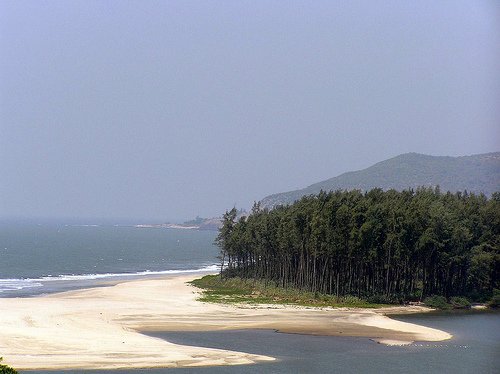
375 km south of Mumbai, Ganapatipule is regarded as one of the most important beaches of Maharashtra. The waters are crystal clear and pristine, entire stretch of beach is covered with fresh greeneries, water sport facilities are also available over here, silver sands, a gentle lapping sea, which soothes frayed nerves, attracts large number of tourists. One can see a glimpse of the entire beach, which is covered with white sand and blue waters from the top of the hill.

Ganapatipule is also known as a pilgrimage site for its 400-year-old temple of Swayambhu Ganpati (naturally formed monolithic Ganesh). Other nearby attractions worth visiting are Malgund and Ratnagiri.

VIJAYDURG – SINDHUDURG:


Vijaydurg is 425 km from Mumbai and Sindhudurg is 510 km, apart from the picturesque beaches these places have lots of historical sites to see, most important of all is the Vijayadurg fort built by hhatrapati Shivaji in the 17th century. The great Maratha ruler Chhatrapati Shivaji used Vijaydurg - Sindhudurg as naval base during his reign. Sindhudurg has temples dedicated to Bhavani, Mahadeo, Jarimai, Mahapurush and Shivaji spreading over 48 acres.

VENGURLA MALVAN BEACH:


Vengurala is 514 km away from Mumbai and 200 km from Ratnagiri. Kolhapur is the nearest railhead, while one can also access this place through Ratnagiri, which is well connected by road. Vengurla is famous for its long stretch of iridescent sand, lined up with thick groves of cashew, coconut, jackfruit and mango. Vengurla rocks is so near to this beach. 
Malvan is thickly covered with palm trees. This place is famous for the temples as well. Malvan was once an important center for trade, which was twice destroyed by the attacks between 1664-1812. There are also forts to visit near by of Malvan namely Sindhudurg and Padmagadh.

TARKARLI BEACH:

Tarkarli is situated 6 km south of Malvan and 546 km from Mumbai on the west coast of India. This place has gained prominence because of its long and narrow stretch of beach with pristine waters. Takarali beach is known for is clearness of water. One can sometimes see the seabed unto a depth of 20 ft. If we look the beach panoramically, the beautiful sailboats and the tiny magnificent islands make the beach more delightful.Nearest railway station is at Kudal on the Konkan Railway, it is easily accessible from Malvan by bus and rickshaw.

All in all, the beaches of Maharashtra are also the place to be visited though they all are not so famous as of Goa, but sure one can have a nice weekend at these places and the best part of the beaches of maharashtra are, the places are not only for beach, but also has some importance including the production of fruits, serving of seafood, pilgrimage of temples and other religion places as well as historical importance, so one can never get tired of sitting on beach, can always have some other activities also possible to do.
So, with this we end this blog and hope you are now well informed of some of the beaches also possible to visit in Maharashtra, hope you enjoyed reading and we look forward for any assistance we may be able to provide for you by contacting us